
Subscribe to Newsletter
Enter your email address below and subscribe to our newsletter

You are the investigator
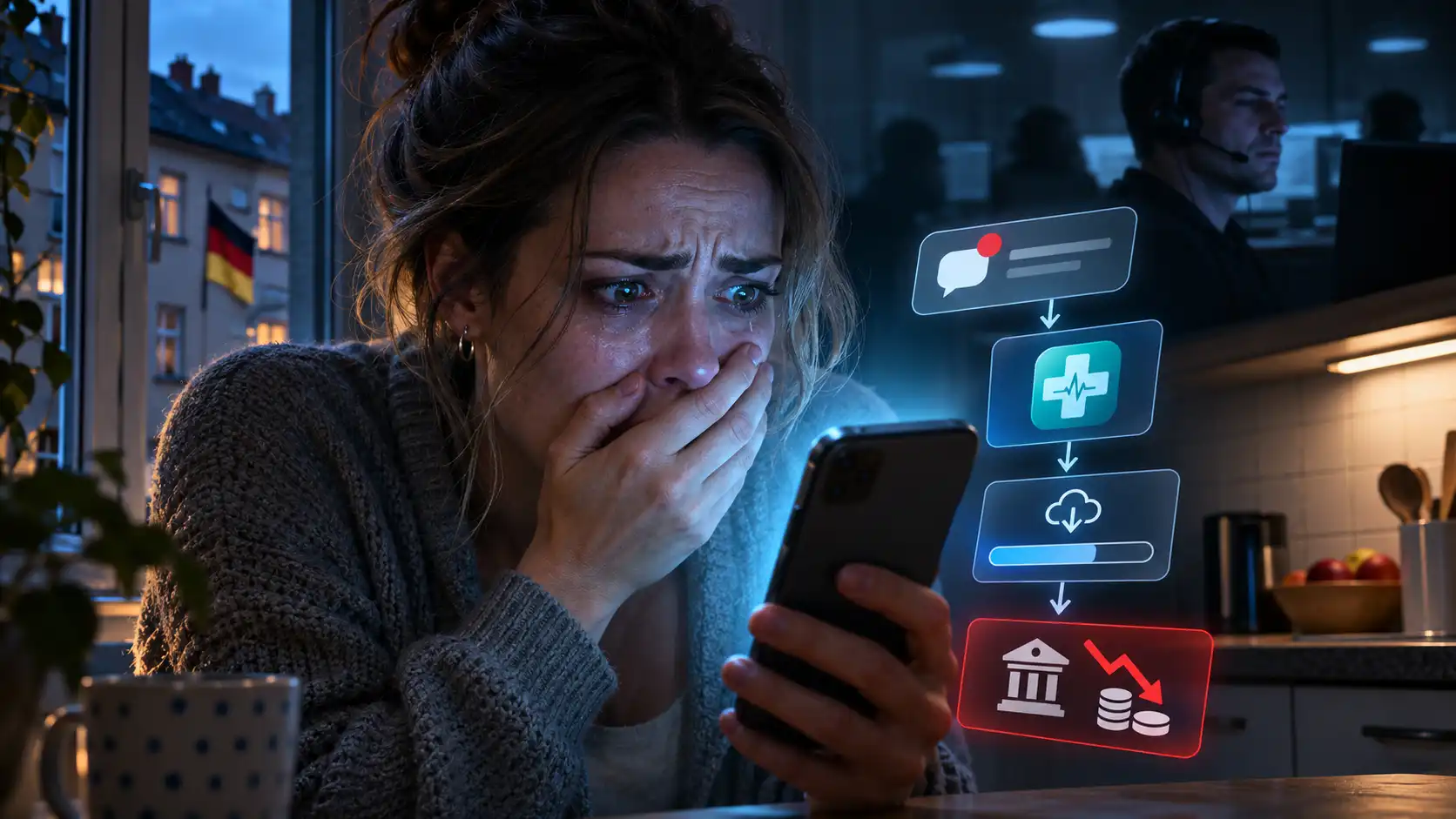
A supposed app update, a friendly phone call, and €7,820 vanish. How the scam works and how to recognize it.
The man on the phone was friendly. He knew her name, spoke calmly, and claimed he only wanted to prevent her electronic medical record from being blocked. By the time Nora realized what had actually happened, her savings were gone. She was particularly tormented later by a sentence the stranger had uttered as he left.
Editor's note:This story is based on a real fraud case. To protect the individuals involved, names, countries, cities, and the names of apps and services have been changed. Some dialogues have been reconstructed to reflect the original meaning. The essential sequence of events remains unchanged.
Nora Lehmann, 34, lived in Leipzig-Gohlis, worked in a pharmacy and finished work early this Thursday.
On the kitchen table lay a shopping list, the car repair bill, and a letter from her health insurance company. She had scheduled a doctor's appointment for the following Tuesday. She had been suffering from back pain for several weeks.
Her mobile phone rang.
An unknown mobile phone number.
„Lehmann?‘
‚Good afternoon, Ms. Lehmann. My name is Daniel Weber. I'm calling on behalf of the technical patient service. Am I speaking with Ms. Nora Lehmann?‘
„Yes.“
„This concerns your electronic patient record. Do you have two minutes?“
Nora put down her shopping bag.
The man spoke slowly and clearly. In the background, quiet voices could be heard, as in a typical open-plan office.
„We have noticed that your ePA app is still using an older security version. A technical upgrade is currently underway. We want to avoid any problems during your next doctor's appointment.“
„What kind of difficulties?“
„In the worst-case scenario, certain digital functions could be temporarily unavailable. That's why we are currently performing an update.“
Nora thought about her doctor's appointment.
„Do I have to pay for that?“
„No, Ms. Lehmann. Of course not. This is a free technical process.“
He sounded almost surprised by the question.
„You just need to update your app.“
Later, Nora would hear this sentence hundreds more times in her mind.
Nora used an Android smartphone. Her banking app, WhatsApp, and her health insurance app were all side by side on her home screen.
She wasn't particularly familiar with the technical settings. But she also wasn't the type of person who opened every link.
„Can't I do that later?“ she asked.
The man remained silent for a moment.
„Of course, you can decide that. However, I cannot guarantee that the update will be processed before your doctor's appointment.“
No threat. No raised voices.
He simply made her feel that procrastination would be the worse decision.
„Okay. What do I have to do?“
‚I'll send you a message with the update access link. You can do this directly on your phone. I'll stay on the line if anything is unclear.“
Seconds later, a text message appeared.
The message stated that a security update for the patient record was available. A link led to a page with a medical-looking logo and a reference to the required new version.
Nora hesitated.
„I usually update my apps via the Play Store.“
‚That's absolutely correct,“ Weber replied without any hesitation. „With this technical change, you will be given direct access to the new version.‘
He said it so matter-of-factly, as if that answered every question.
The page contained a button labeled „Start update“.
Nora guessed it.
A file was downloaded. When she tried to start the installation, a security warning appeared on her smartphone.
‚It says here that the app comes from an unknown source.‘
‚Yes, that can be displayed during a manual update,‘ the man replied. „I'll explain what you're seeing on the screen.“
Nora looked at her watch. She had actually wanted to do some shopping before the supermarket closed.
The man had time.
He seemed to have an endless supply of it.
After a few more prompts, the warning disappeared. The supposed update was installed. Nora also granted access rights whose meaning she didn't understand.
Then a screen with a loading circle appeared.
‚Being prepared. Please wait.‘
‚This may take a moment,‘ said Weber.
While Nora stared at the screen, her phone vibrated.
A notification appeared in her banking app.
She didn't read the entire text. Something about a security procedure and a release.
„Now I’m also receiving something from my bank,“ she said, surprised.
„That could be related to the equipment testing,“ Weber replied.
‚From my bank?‘
‚If you are unsure, you can calmly check the instructions on your screen.‘
His voice remained unchanged.
Nora looked at her phone again. She had been on this call for almost twenty minutes now. The supposed update had started, and she wanted to finish it.
A confirmation prompt appeared on the display.
She still believed it was a technical security check.
Nora confirmed.
What she didn't know: The unfamiliar application wasn't an update to her medical records. It was malware that gave criminals access to information and functions on her smartphone. With the stolen data and the transactions Nora confirmed, they were able to compromise her bank account.
When a second confirmation appeared later, she was already so exhausted from the technical instructions that she barely asked any questions.
‚Is this the last one?‘
‚We'll be finished in a moment, Mrs. Lehmann.‘
She also confirmed this.
The man thanked him.
‚The update is complete. You can now use your phone normally again.‘
‚And my doctor's appointment?‘
‚There shouldn't be any difficulties.‘
‚Thank you so much for your help.‘
„With pleasure, Ms. Lehmann. I wish you a pleasant evening.“
Then he hung up.
Nora turned off the screen.
She was relieved. Finally, she could take care of dinner.
Perhaps a quarter of an hour later, she opened her banking app. Not out of suspicion. She just wanted to check if her salary had already been deposited.
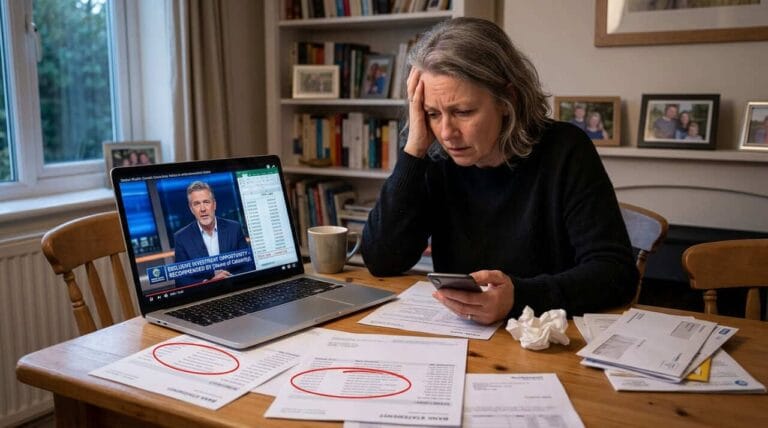
The bank balance froze her.
Available for: 184.37 euros.
She closed the app.
She opened it again.
The same result.
The sales overview contained two transfers that she did not recognize.
4,980 euros.
2,840 euros.
A total of 7,820 euros.
Nora stared at the numbers.
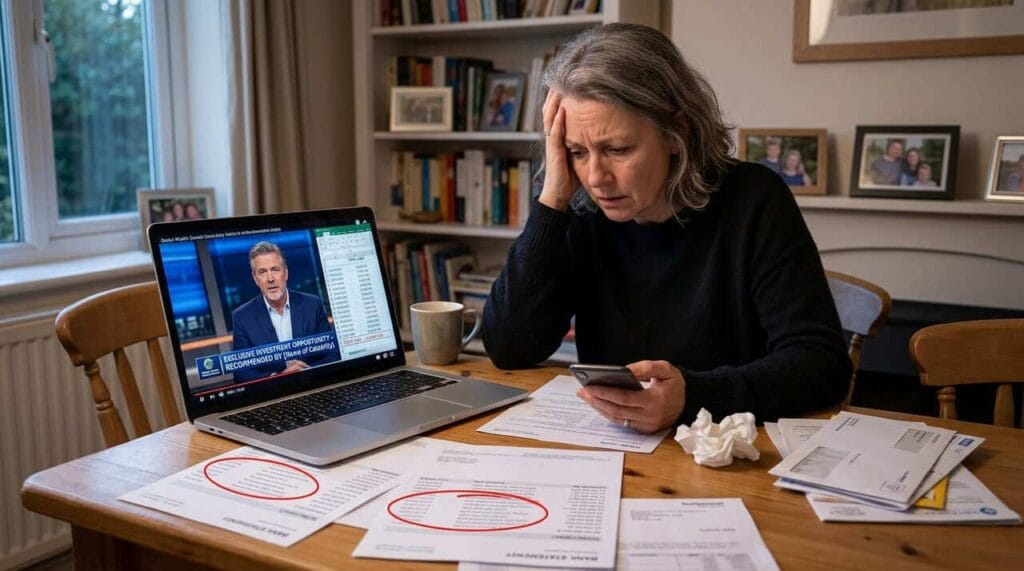
The money was intended for a new car. She had saved some of it over the years, usually 100 or 150 euros a month. This was supplemented by overtime pay, Christmas bonuses, and the money her grandmother had given her shortly before her death.
Nora didn't have much in the way of savings. But she did have these 7,820 euros.
Now they were gone.
At first she thought it was a mistake.
Perhaps the app displayed something incorrectly. Perhaps the account was temporarily blocked.
She called her bank.
While she was on hold, her right hand began to tremble.
„I think something has happened to me,“ she said when a staff member finally answered.
„What exactly do you mean?“
‚There are two transfers. I didn't make them.‘
The employee asked questions. Nora tried to answer.
Then she heard:
‚Ms. Lehmann, we must assume that your online banking has been compromised. We are immediately blocking the affected accounts and checking whether anything can still be done to stop it.‘
‚But I haven't transferred anything!‘
‚I understand. We must first prevent further damage.‘
‚Will I get my money back?‘
At the other end, a pause occurred.
‚That cannot be said at the moment.‘
Nora sat down on the kitchen floor.
She couldn't explain why she sat down there of all places. Perhaps because she suddenly felt like her legs would no longer support her.
The refrigerator hummed.
A tram passed by outside.
Everything sounded the same as always.
But within a few minutes, their lives felt completely different.
In the evening, Nora called her older sister.
‚Can you come?‘
‚,What happened?‘
Nora wanted to tell the story, but her voice failed her.
When her sister arrived at the door half an hour later, Nora was still sitting in the kitchen.
The mobile phone was lying on the table.
‚I let someone use my phone,‘ she whispered.
Her sister sat down next to her.
‚,Who?‘
‚A man from the health insurance company. Well... I thought he was from the health insurance company.‘
Then Nora told everything.
The phone call. The text message. The update. The bank messages.
With every detail, it became clearer to her how carefully the stranger had guided her through the conversation.
‚Why did I do that?‘ she kept asking.
Her sister tried to calm her down.
But Nora was already thinking about how she would tell her mother. What her colleagues would say. Whether the bank would accuse her of acting recklessly.
And above all, she thought of herself.
She was 34 years old. She used her smartphone daily. She had often read warnings about fraudulent phone calls.
Nevertheless, it had worked.
‚I'm not stupid,‘ she said suddenly.
Her sister took her hand.
‚,No.‘
‚But that's exactly how I feel.‘
Nora hardly slept that night.
As soon as she closed her eyes, she heard the man's voice:
„I'll stay on the phone until everything works.".„
He hadn't even sounded unfriendly.
That was perhaps the worst part.
The next morning, Nora went to the police.
She had kept the text message, the call in her call log, and the bank statements. Her bank had been informed and her accounts blocked. Now her smartphone also had to be examined.
The official took her report.
‚Did you know the caller personally?‘
‚,No.‘
‚Did he claim to work for your health insurance company?‘
‚,Yes.‘
‚Did you call the number back?‘
‚Several times. No connection is established.‘
Nora showed him the message history.
The official reviewed the information.
‚The displayed phone number does not necessarily show the actual origin of the call,‘ he explained.
Nora found this incomprehensible.
Someone knew her name. They exploited her fear of a problem with her patient file. They spoke with her for almost half an hour.
And now this person had simply disappeared.
‚Can you find out who this was?‘
‚We are securing the available evidence and examining what investigative measures are possible,‘ the officer replied. ‚However, I cannot promise you that the perpetrator will be identified.‘
Nora nodded.
She had hoped for a different answer.
Two days later, Nora received a clear answer during a personal visit to her health insurance company.
No corresponding update had been initiated there.
There was no employee named Daniel Weber who had called them about this matter.
And their actual ePA app had not been affected by the incident at all.
Nora sat in front of the clerk and tried to understand what that meant.
‚So the man knew I would believe him?‘
‚He apparently impersonated an employee of a trusted service,‘ the woman replied.
Nora thought about the phone call again.
I remember the pauses the man took when she became uncertain.
To his patience.
The way he never phrased anything directly as a threat, but always only explained to her what could supposedly happen.
She had imagined a con man to be different.
Someone who became aggressive. Who put her under pressure. Who impatiently asked for money.
This man had never asked for money.
He had even reminded her to read the instructions on the screen.
And that's precisely why he had been so convincing.
Nora now understood that the stranger had not wanted to save her patient file all along.
He had been waiting for something.
That she herself carried out the crucial confirmations.
Three weeks after the phone call, Nora received more mail from her bank.
The investigation into the unauthorized transfers was ongoing. It remained unclear whether and to what extent the damage would be compensated.
Her account was now usable again. After the evidence was secured, she had her smartphone reset, changed her passwords, and activated additional security measures.
But every time an unknown number called, she was frightened.
Once, an employee of her health insurance company actually contacted her with a completely ordinary inquiry.
Nora hung up immediately.
She only called back later using the official service number.
„I’m sorry,“ she said to the employee. „I’m being a little cautious about making calls like this at the moment.“
‚That's perfectly fine.‘
These four words did her a surprising amount of good.
A few days later, Nora was sitting in a cafe with her sister.
‚Do you know what I think about most?‘ she asked.
‚About the money?‘
Nora shook her head.
‚Of course. But I remember that I thanked him.‘
She stared into her coffee cup.
‚I thanked the man who just emptied my account.‘
Her sister didn't know what to say to that.
Nora smiled briefly. It wasn't a happy smile.
‚And he wished me a nice evening.‘
Nora's story illustrates a fraudulent method in which criminals exploit trust in well-known institutions to introduce malware onto smartphones.
In Germany, for example, fraudsters could misuse the name of a health insurance company, a doctor's office, an online banking provider, or a well-known digital service.
The electronic patient record, or ePA for short, is a genuine offering of the German healthcare system. Insured individuals can use their health insurance company's official application for it. The alleged security update in Nora's story, however, was completely fabricated.
The scam doesn't work because every piece of malware installed could automatically empty all bank accounts. The crucial factor is the interplay of deception, unauthorized app access, potentially stolen login credentials, and fraudulently obtained permissions.
The following warning signs are particularly important:
– An alleged service employee calls unexpectedly and demands an immediate app update.
– The download should be done via a link in an SMS or messenger message.
– An app from an unknown source is to be installed.
– The application requests unusual permissions.
– During the alleged update, banking permissions appear that have nothing to do with the original request.
Anyone who has already installed a suspicious application should refrain from using the affected device for sensitive processes, disconnect from the internet, inform the bank via a secure communication channel, and secure evidence. Filing a police report is then advisable.
Further information is available from the Consumer advice center on fake SMS messages and harmful apps as well as the Federal Office for Information Security (BSI).
Nora had not applied for a loan, visited any unfamiliar websites, or voluntarily sent money to any stranger on that Thursday.
She simply wanted her medical data to be available for her next doctor's appointment.
For a person, that was an everyday worry.
For the con man, it was the beginning of a business.
And while Nora pondered for weeks why she had trusted him, the call was probably long over for the man on the other end.
Perhaps he got himself a coffee after the conversation.
Perhaps he was already dialing the next number.
And began again with the same friendly sentence:
„Good day. This concerns an important security update for your app.".„
“More cases from the category of artifacts“: