





Subscribe to Newsletter
Enter your email address below and subscribe to our newsletter

You are the investigator

Intimidation methods used by telephone scammers: Learn how nasty shock calls work and how to effectively protect yourself from fraud.
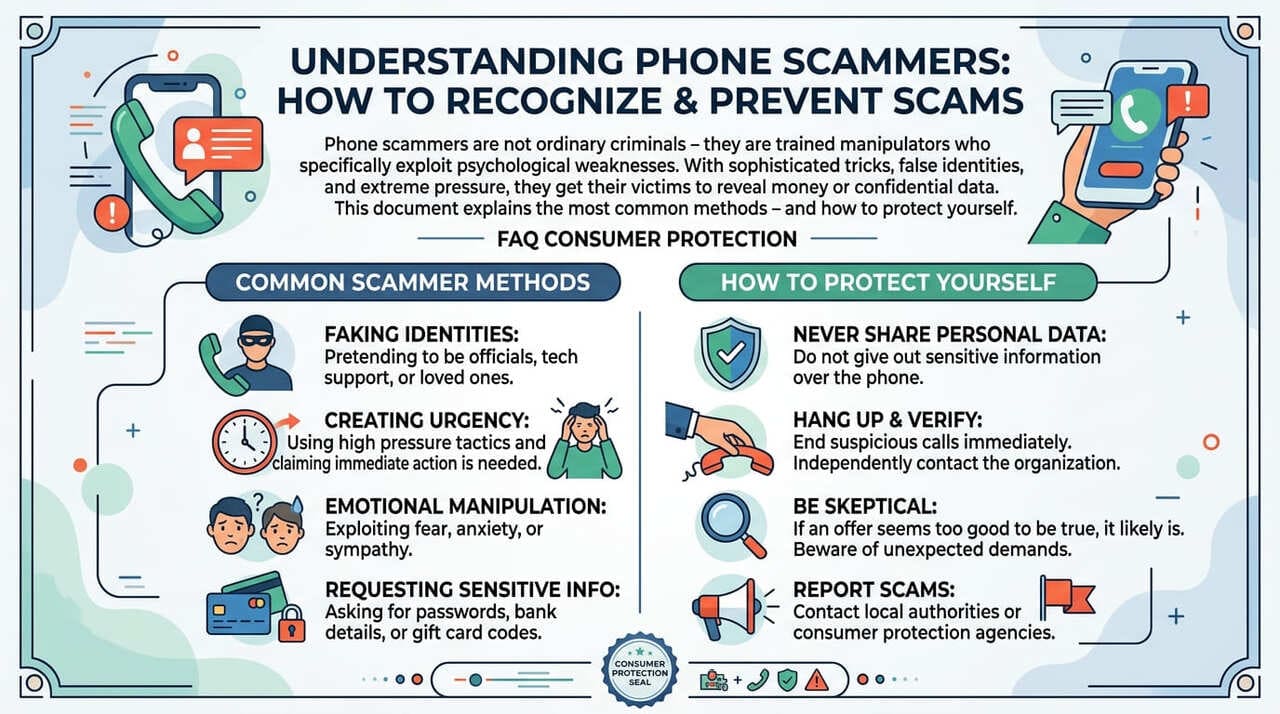
Telephone scammers are not ordinary criminals – they are trained manipulators who exploit psychological weaknesses. Using sophisticated tricks, false identities, and extreme pressure, they trick their victims into revealing money or confidential information. This document explains the most common methods – and how to protect yourself. FAQ Consumer Protection
Telephone scammers don't operate randomly – they follow a proven system. Their methods can be traced back to four key intimidation strategies, which are used individually or in combination. Those who are aware of these methods are significantly better protected.
The perpetrators pose as police officers, prosecutors, Europol investigators, bank employees or tax office officials – roles that demand respect and obedience.
„"Act now – or it will be too late!" The feigned urgency is intended to give the victim no time to think.
Arrest warrants, account freezes, seizures, criminal charges – the range of threatened consequences is large and intimidating.
The fear for children or grandchildren is shamelessly exploited. Faked accidents and weeping "relatives" in the background are used to disable sound judgment.
Know these four strategies – and you've already built a crucial protective shield.

The so-called shock call is one of the most gruesome methods in the repertoire of telephone scammers. The perpetrators claim that a close relative – often their own child or grandchild – has caused a serious or even fatal traffic accident. The message comes without warning, delivered with the utmost emotional intensity: "Your granddaughter has killed someone. She is in custody. Only an immediate bail payment can save her."„

The effect is devastating: The news triggers an extreme state of shock in the victims. In this exceptional situation, rational thinking almost completely shuts down. This is precisely what the perpetrators are counting on. While the victim is still reeling from the initial shock, the fraudsters employ further manipulation tactics: In the background, one can hear crying, sobbing, or even screaming – often from paid actors meant to imitate the bereaved.
Particularly insidious: The perpetrators give no respite. They immediately ask about any cash available in the house, jewelry, or other valuables. Every second of hesitation is a second in which the scam could be exposed. Therefore, they maintain constant pressure until the victim agrees. Many elderly people who have never heard of this scam fall for it – even if they are otherwise very careful and cautious.
A key tool of intimidation is the concrete threat. The more specific and realistic the threatened consequences sound, the more pressure is exerted on the victim. Scammers have developed a wide arsenal of threat scenarios, which they deploy strategically depending on the victim's reaction.
„"Officers will be coming to your home in 30 minutes." The threat of imminent arrest creates pure panic and stress.
„"All your accounts will be frozen." The idea of no longer having access to one's own money is extremely frightening for many people.
High fees, allegedly already accrued, are intended to reinforce the feeling that it is already "too late" to do nothing.
The threat of having furniture, jewelry, or savings seized particularly affects older people with a high need for security.
„"You are under investigation for undeclared work." Even if the accusation is absurd, the mere mention of "criminal charges" causes great stress.
Important: Genuine authorities never threaten immediate arrest or account freezing over the phone. Such statements are a clear warning sign.
As soon as the victim hangs up or makes a call, the scam is immediately exposed. Therefore, isolating the victim from the call is the perpetrators' most important tool.
Typical phrases used by scammers:
The scammers know exactly that: as soon as the victim contacts another person – be it a family member, the real police, or the bank – the scam is immediately obvious. That's why they link the hanging up call with extreme threats.
Isolation is particularly effective for older people who live alone. In a stressful situation, they lack the immediate opportunity to ask someone, "Is this normal? Should I really be doing this?" Perpetrators deliberately exploit this natural security gap.
Remember: A reputable official or bank advisor will never instruct you not to end the call or to speak to anyone. This demand alone is an irrefutable sign of fraud.
Telephone scammers aren't rigid robots – they're flexible manipulators. If the initial friendly approach doesn't yield the desired results and the victim begins to have doubts, they deliberately change tactics. The seemingly helpful, official voice suddenly transforms into an aggressive, domineering tone.
This escalation is no accident, but a deliberate method: Speaking loudly, constantly interrupting, and aggressively interrupting the victim are intended to demonstrate dominance and break resistance. Anyone who is constantly interrupted and barely gets a word in edgewise loses their sense of control over the situation. That is precisely the intention.
Short, command-like sentences such as "Listen to me!" or "Answer my question!" create a feeling of hierarchy and submission.
„"By not cooperating, you are guilty of obstruction of justice!" – A fabricated crime is intended to put the victim on the defensive.


File numbers, paragraph numbers and technical terms are listed so quickly that the victim is overwhelmed and stops asking questions.
This deliberate shift from friendly to aggressive serves a clear purpose: to unsettle and intimidate the victim, so that in the end, driven by the desire to end the conflict, they simply give in. Knowing about this method allows you to take a step back and think clearly.
In so-called caller ID spoofing, perpetrators manipulate the telephone technology so that a completely fake phone number appears on the victim's display. Instead of the fraudsters' real number, the victim sees, for example, 110 (the police emergency number) or the number of the local savings bank.
The psychological effect is enormous: Anyone who sees "Police" or a familiar bank number on their phone display is unlikely to doubt the call's authenticity. The spoofed number lends the fraud an air of legitimacy that masks all other warning signs.
Technically, spoofing is possible with relatively simple means and is widespread in the criminal world. It's important to know: even if the displayed number looks official, this proves absolutely nothing about the caller's true identity.
The real police never call from the emergency number 110! This number is exclusively for emergency calls from citizens to the police – not the other way around.
Police emergency call
Local bank branch
Official government number
International Authority
Despite all their sophisticated methods, telephone scammers always leave recognizable traces. Those who know the typical warning signs can react clearly at the crucial moment – even when the emotional stress is very high.
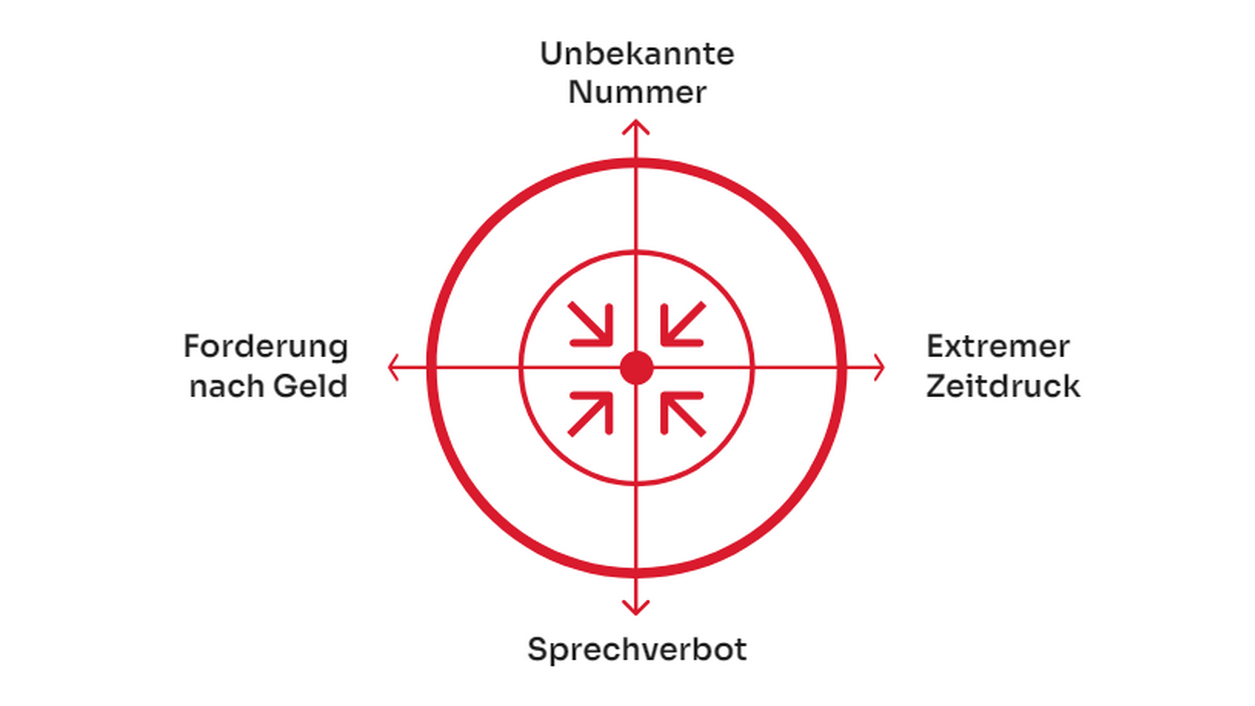
Each of these four characteristics alone should already raise red flags. If several occur simultaneously—which is almost always the case with telephone fraud—then the probability of a fraud attempt is virtually 100%. Trust your instincts: If something feels wrong, it very likely is.
If you are pressured, intimidated, or threatened over the phone, there are clear rules of conduct. These rules apply regardless of how convincing the caller sounds or which number appears on your display. Memorize these steps—ideally before you ever find yourself in such a situation.
End the call without explanation, apology, or farewell phrases. You owe the caller nothing. Simply hang up – it's your right.
Real police officers, prosecutors, and bank employees never demand money, valuables, or account details over the phone and do not threaten immediate arrest.
Call the alleged authority back using an official number you have researched yourself. Never press the redial button – that will connect you directly to the scammers.
Never give out PINs, passwords, account details, information about cash in the house or other personal information – no matter how official the caller sounds.
Report the incident via the normal landline number of your local police station – not via 110, but via the regular office line which you can find in the telephone book.
Telephone fraud affects people of all ages, but older people are particularly often targeted. The best protection is knowledge – and sharing that knowledge with family and friends. Talk openly about these scams, because once someone has heard about them, they are much harder to manipulate.
Talk to older relatives about telephone scams. Agree on a secret code word for genuine family emergencies – this way you can quickly check if a call is real if you're unsure.
Many phones and smartphones offer the option to block unknown numbers directly or forward calls to voicemail. Use this feature actively.
Write down the most important rules on a piece of paper and stick it by the phone: "Never mention money. Hang up. Call back using your own number." A quick glance can save lives in a stressful situation.
„"Real authorities don't intimidate you – they protect you. Anyone who threatens and pressures you on the phone is not a civil servant."“
When in doubt, always hang up. It's the safest decision you can make. No legitimate caller will hold it against you – and a scammer can't harm you once the call is over. Share this knowledge – it can save lives and money.