



Subscribe to Newsletter
Enter your email address below and subscribe to our newsletter

You are the investigator
LIFE IN GERMANY | HUMOR & EVERYDAY LIFE
„In Germany, I didn't just learn German. I also got to know the bureaucratic red tape. And this beast neighs especially loudly when a form is missing.“ 🤔
Learned German, passed A2 level, but still didn't understand anything at the government office? Welcome to Germany! Here I tell you how an electrician became my first interpreter, why „Ich bitte Sie“ sometimes sounds like a final warning, and why you need at least B2 level German to marry a bureaucrat.
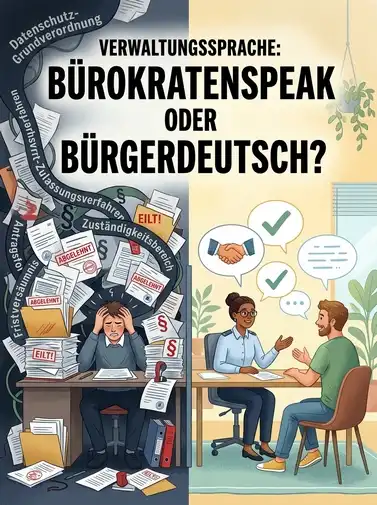
My first real encounter with bureaucratic German wasn't at the job center, the social welfare office, or even the immigration office. It began with a disaster: my internet stopped working.
At the time, I didn't have a German bank card. Something had gone wrong with the payment. So I took my payment receipt and went to the seller in person.
A friendly young woman sat behind the desk. She smiled and began to speak:
„Due to the lack of timely receipt of payment for the current billing period, a temporary restriction of the contractually agreed service provision had to be implemented.“
I looked at her.
„I'm sorry, what?“
She smiled again and repeated the same sentence. Perhaps a little slower, but no more clearly.
I understood individual words: payment, period, service. My internet connection must be hidden somewhere in there.
Luckily, an electrician was working in the same room. He had overheard our conversation, put his tools aside, and explained to me:
„Your money is ruined!“
Suddenly I understood everything.
„But I paid!“ I replied, showing my receipt.
The employee looked at the paper and explained:
„The proof of payment you submitted relates to a billing period that has already been completed and therefore cannot be considered as proof of payment received for the currently outstanding claim.“
I looked back at the electrician.
He translated:
„Paid for September. Not paid for October.“
Oh right!
Finally, someone I could speak German with.
„Okay, I'll pay now. Will I have internet again today?“
The employee replied:
„The restoration of service provision can only be initiated after the receipt of payment has been recorded in the accounting system and the relevant data has been successfully processed by the responsible body.“
I looked at the electrician. He nodded.
„Yes. Today. If not today, then one hundred percent tomorrow.“
Since that day I know: In Germany, you sometimes don't need an interpreter for German. You need an interpreter for bureaucratic German.
And I was lucky. My interpreter wore work clothes, held a screwdriver in his hand, and needed exactly five words to replace an entire administrative department.
The conversations are paraphrased from my memory; the lengthy official pronouncements have been recreated for the sake of this humorous story.
Later I learned that the story with the internet was just the beginning.
In Germany, there are integration courses, language tests, and certificates. You learn how to introduce yourself, talk about your family, make a doctor's appointment, and ask for directions.
For example, with A2 I can say:
„I am looking for work.“
Then I go to the job center and hear:
„Please submit appropriate evidence of your previous efforts to take up employment subject to social security contributions.“
Excuse me, what?
Simple German: „Show us where you applied.“
My ironic translation: „They claim to be looking for work. Now we'd like some proof of this bold theory.“
And that is the great contradiction I experience again and again in Germany: I am required to provide proof of language proficiency, while on the other side of the desk a language is spoken that is not included in my A2 textbook.
Of course, not all employees speak like that. Some explain everything patiently and clearly. But with some, I get the feeling they're afraid that a simple sentence might violate a company policy.
I now suspect that every government agency has a secret language course:
„How do I turn five understandable words into a sentence with 37 words, four nominalizations and no recognizable main information?“
The final exam probably consists of transforming the sentence „Please bring your ID“ into a formulation that not even the ID understands.
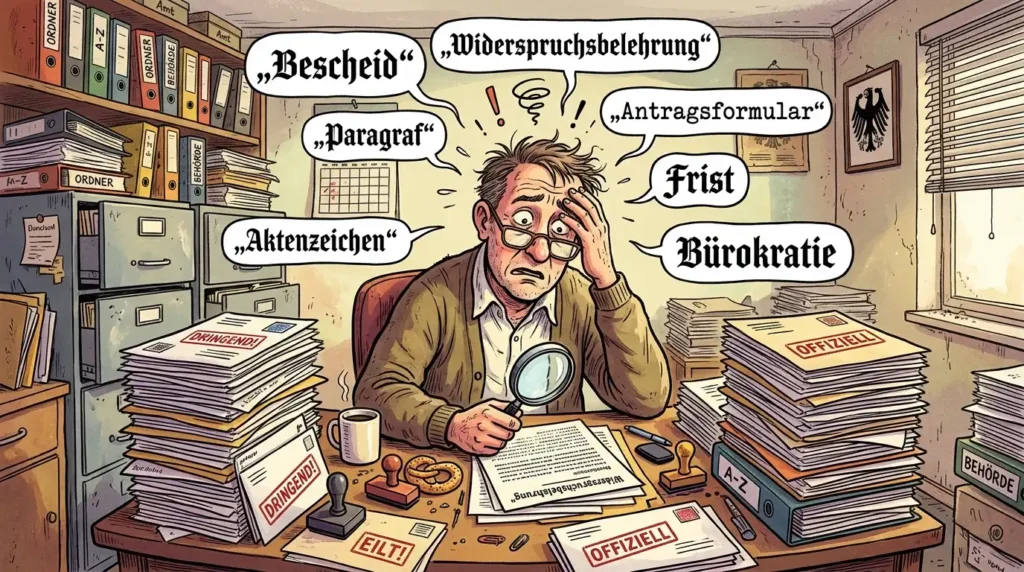
Over time, I've learned that bureaucratic German has its own rules. The language authorities use to remain polite, even when making the same request for the third time, is particularly interesting.
Here is my personal dictionary. The column „Plain German“ explains the actual meaning. My ironic translation, on the other hand, describes how such sentences sometimes feel.
| Officialese | Simple German | My ironic translation |
|---|---|---|
| I ask you to… | Please do that. | I'm still being polite. Take advantage of the opportunity. |
| I urge you to… | You have to do that. | The fun is over now! |
| I urge you once again to… | I've already said it. Please do it. | My blood pressure is rising. |
| I hereby make a final request of you to… | This is my final request. | One more letter and I'll explode in triplicate. |
| To clear up any misunderstandings… | So that we understand each other correctly… | I will now explain why I am right. |
| Clarify the facts | Find out what happened. | We need to determine where you went wrong. |
| Clarify the current situation transparently | Understanding the situation together. | We'll discuss everything again. This time with a file folder. |
| I acknowledge your comments. | I heard what you said. | Interesting opinion. My file remains unchanged nonetheless. |
| This is not the subject of the hearing. | We're not going to talk about that now. | Please don't disrupt my agenda with your arguments. |
| This is unrelated to this. | That's a different question. | New process, new luck. |
| Please refrain from further inquiries. | Please do not ask any further questions about this. | My inbox needs a vacation. |
My favorite combination is:
„I therefore politely request once again that you fulfill your obligation to cooperate without delay in order to clear up any existing misunderstandings and to definitively clarify the matter.“
In simple German:
„Please finally send us the missing documents.“
In my inner German:
„IF THESE PAPERS DON'T ARRIVE, I'LL HAVE TO WRITE ANOTHER LETTER!“
The wonderful thing about bureaucratic German is that nobody has to shout. You can put all your despair into the word „again“ and still remain professional.
Words that initially sound completely harmless are particularly dangerous.
For example, the duty to cooperate.
At first, I thought it meant we would work together. Perhaps a friendly conversation where both sides explain something.
In officialese, this can mean that I have to provide certain information, answer questions, or submit required documents.
And of course, there's a wonderful word for that: catching up on participation.
Simple German: „Do now what you haven't done before.“
My translation: „We have already written to you. You did not respond. Now we are writing to you to say that we have already written to you.“
Another word is consultation.
I learned „speaking“ as „talking.“ Therefore, when I heard „personal consultation,“ I initially imagined that I would be allowed to speak in person.
In fact, it means I have to appear in person at the authority.
It gets even better with „on time“ and „without delay“.
In important documents, these terms should not be interpreted humorously. Deadlines, obligations, and potential consequences, in particular, must be carefully examined. My ironic translations are, after all, no substitute for the law.
Let's imagine a completely normal visit to the social welfare office.
The employee looks at his screen.
„For what reasons has the timely submission of the requested documents not yet been made?“
I'm trying to translate this.
For what reasons does „Why“ mean?
Documents means „papers“.
"Haven't happened so far" probably means that nothing has happened.
So I ask:
„You mean why I haven't brought the papers yet?“
„Yes.“
Wonderful. We did it! One minute of German lesson and two people understand each other.
I declare:
„Because I haven't received the document yet.“
He types something into his computer:
„The applicant states that the subsequent submission is currently not possible due to the lack of provision of the required evidence.“
I look at the screen.
That's me. My simple sentence has had a career. He's just been promoted to administrative officer.
Perhaps a sentence in Germany grows with every signature. First it says, „I don't have the document.“ Three offices later it reads, „The current unavailability of the required supporting document prevents final processing of the case.“.
And at some point, a letter arrives requesting written proof of unavailability.
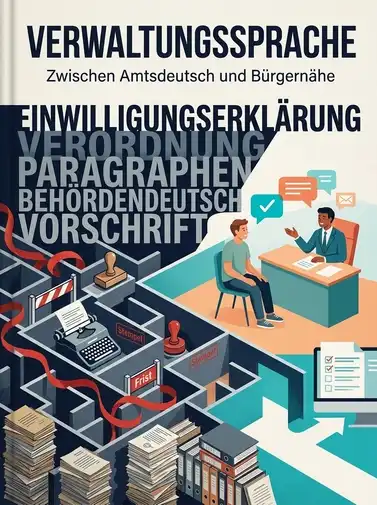
After all these experiences, I imagined what professional life would be like if bosses were only allowed to use bureaucratic German.
The boss comes to the workshop in the morning.
Normally he would say:
„Can you please close the window? It's cold.“
But as a state-certified master of administrative prose, he says:
„I urge you to immediately take appropriate measures to restore the proper closing condition of the room-side window opening.“
The new employee stands up, looks at the radiator and asks:
„Do I need to repair something?“
„No. Close the window!“
Next time, we'll talk about a coffee break.
„The temporary interruption of the work contractually owed for the purpose of consuming caffeinated hot drinks requires prior agreement.“
Simple German: „Please ask before you take your coffee break.“
My translation: „You may drink coffee, but first I would like to discuss this with three departments.“
The employee replies:
„I hereby request permission to conduct a five-minute coffee consumption exercise.“
Boss:
„Your application is being processed.“
Employees:
„When will I get my coffee?“
Boss:
„After a final review of operational requirements.“
In the end, the employee does not resign. He requests the „permanent termination of the obligation to be present, taking into account the applicable notice period“.
I have another theory: People who speak bureaucratic German all day long will eventually be unable to switch it off at home either.
Let's imagine I had married a woman who had been working in a German government agency for 20 years.
She might have written to me earlier:
„Honey, please bring broccoli. ❤️“
After 20 years of service, I receive a message:
Dear husband,
During today's preparations for the communal evening meal, the absence of a plant ingredient from the species Brassica oleracea, required for the proper execution of the planned cooking process, was discovered.
You are hereby politely requested to arrange for the timely procurement of a commercially available quantity of broccoli.
Best regards
Your wife
Simple German: „Honey, please buy broccoli.“
My translation: „If you come home without broccoli, legal proceedings will be initiated.“
Of course, I will answer correctly:
„Dear wife, I hereby acknowledge receipt of your procurement request. Implementation of this measure is subject to the availability of corresponding stock in local retail outlets.“
Simple German: „Okay, I'll buy it if there is one.“
Your Answer:
„I urge you once again to refrain from further delays.“
Simple German: „Hurry up.“
My translation: „You're sleeping on the sofa today.“
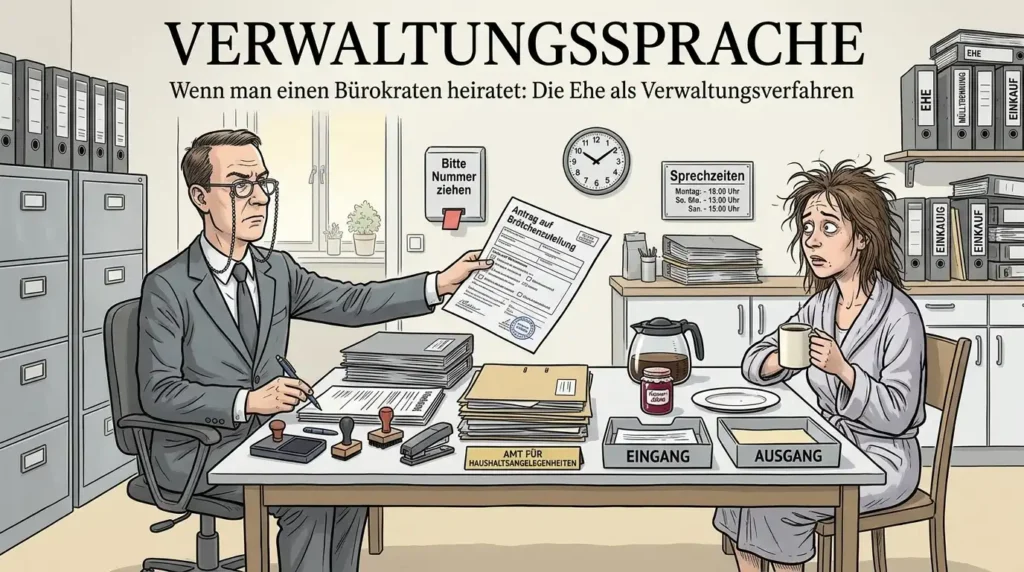
In the evening we sit on the sofa. I promised to take out the trash, but I forgot.
She says:
„Despite repeated verbal requests, the task assigned to you of emptying the waste containers has not yet been properly fulfilled.“
I'm translating:
„I'm supposed to take out the trash.“
„I hereby request, for the last time, that you immediately comply with your obligation to cooperate in matters relating to the budget.“
Now I understand: immediately!
For security reasons, I'm asking anyway:
„Could you please give me that in writing?“
That was a mistake.
Ten minutes later I find a letter on the kitchen table with the subject:
„Final request to remedy a repeatedly observed violation of domestic waste disposal regulations“
Attachment 1: Photo of the trash can.
Appendix 2: Previous memories.
Annex 3: Information on the legal consequences regarding the temporary restriction of spousal gifts.
Since then, I've been taking out the trash voluntarily.
Normal person:
„Will you marry me?“
Bureaucrat:
„I hereby submit to you a proposal for the consensual establishment of a legally recognized cohabitation intended to last indefinitely, with the assumption of the resulting mutual obligations.“
Simple German: „Will you marry me?“
My translation: „I love you. Please sign on page 4.“
And what if she agrees?
„The present application is, in principle, approved after a thorough examination of the personal and economic requirements.“
This is probably the most romantic „yes“ ever documented in a German file.
I imagine planning a vacation would be even more enjoyable if the whole family spoke bureaucratic German.
My son is coming to me:
„Dad, can we go to the seaside this summer?“
I will answer:
„Your application for a family-related recreational measure outside your usual place of residence will be examined taking into account the current budget situation.“
Simple German: „Let's see if we have enough money.“
My wife intervenes:
„I request timely notification of the expected start date of the trip and the planned duration of the temporary absence from the area.“
Simple German: „When are we going and for how long?“
My son has now understood the German authorities better than I do and replies:
„I urge you once again to make a final decision!“
Simple German: „Finally say yes or no!“
Then I explain:
„Due to the currently unresolved financing situation, a binding commitment cannot be made at this time.“
Simple German: „We have no money.“
My wife says:
„Why didn't you say so right away?“
Because I am now integrated.
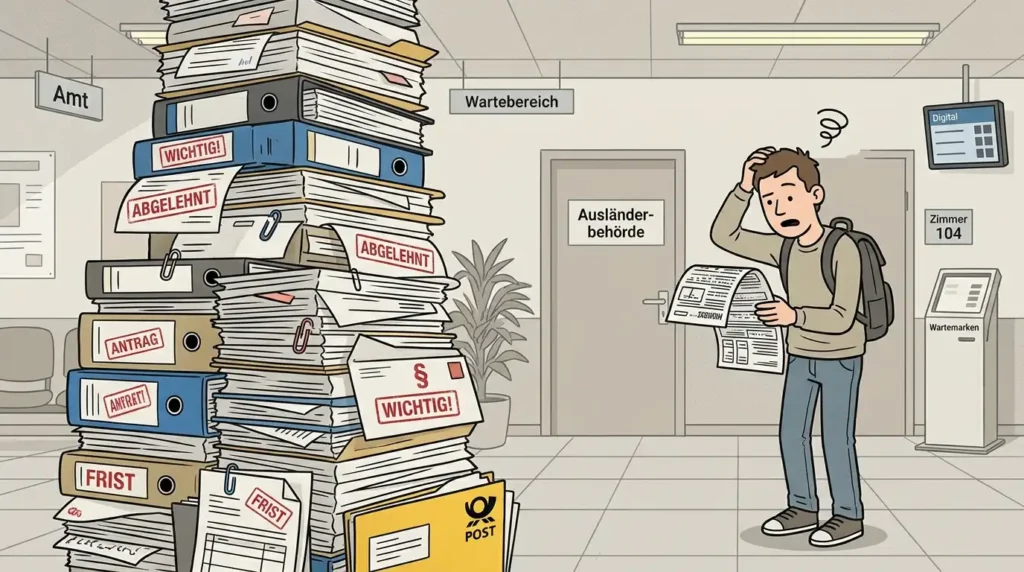
Another classic is the post office.
I used to be happy when I received a letter. Now I always look at the sender first.
If it says Jobcenter, social welfare office or immigration office, I make myself a coffee, sit down and start reading.
I find sentences like these particularly interesting:
„As part of the final review of your request, we feel compelled to ask you for additional information regarding your actual living circumstances.“
Simple German: „We still need information from you.“
My translation: „We have found your application. Unfortunately, we are still missing three reasons not to process it completely.“
Or this wonderful sentence:
„The decision on your application will be postponed until all relevant documents are available.“
Simple German: „We cannot decide yet. Important documents are missing.“
My translation: „Your application can remain in the waiting room.“
The wording is particularly impressive:
„Please refrain from submitting any further status inquiries.“
Simple German: „Please do not ask about the status again for now.“
My translation: „We know you're waiting. We just don't want to be constantly reminded.“
The problem is: After five such letters, I know what „status inquiry“ means, but I still don't know when I'll get a reply.
Sometimes I imagine that bureaucratic German would completely take over Germany.
I enter a snack bar and say:
„One currywurst with fries, please.“
The seller replies:
„The provision of a thermally treated meat product with a potato-based side dish prepared in hot fat, as requested by you, is subject to current product availability.“
Simple German: „Yes, we have currywurst with fries.“
„And ketchup?“
„The additional provision of a tomato-based seasoning can be arranged upon explicit request.“
„Yes, please.“
„Your verbal declaration of intent has been acknowledged.“
After ten minutes I ask:
„Is my food ready?“
„The preparation process is at an advanced stage of processing.“
Simple German: „Almost ready.“
My translation: „The sausage is not ready yet. Please do not bother the cook.“
I'm sure the currywurst in this restaurant will be cold before the vendor has finished his sentence.
I now have a small collection of expressions that no longer cause me to panic.
| Officialese | Simple German |
|---|---|
| Prompt feedback is requested. | Please reply soon. |
| The documents must be submitted later. | Please send the missing documents later. |
| A final decision is still pending. | No final decision has been made yet. |
| The matter was forwarded to the appropriate authority. | We have sent it to the relevant authority. |
| Further clarification is needed. | We still need to check something. |
| Your request is being processed. | We're still working on it. |
| The application cannot be processed at this time. | We cannot yet make a decision on the application. |
| You will be asked to appear in person. | Please come in person. |
| An extension of the deadline may be granted upon request. | You can ask for more time. |
| Further prosecution of the matter will be discontinued. | We will not pursue this matter further. |
My favorite remains:
„The matter will be reviewed again.“
That sounds wonderful. Almost medical.
I imagine my application lying on an examination table while three clerks with stethoscopes stand around it.
„My colleague, the application continues to show clear signs of a lack of cooperation.“
„Then we will prescribe two tests daily and a follow-up appointment in four weeks.“
Despite the humor, many of these formulations are based on actual legal rules. Not every complicated sentence is unnecessary, and not every clerk is allowed to simply change a legally defined meaning.
But the language could often be much clearer. Incidentally, the German administration itself agrees: In the official... Handbook for clear writing Short sentences, familiar words, and concrete formulations are recommended. Also, the Society for German Language deals with citizen-friendly administrative language.
Therefore, I've adopted a method. When I hear a complicated sentence, I no longer try to translate every single word immediately. I look for the actual task.
I particularly like this sentence:
„Excuse me, I understand German, but officialese is difficult for me. Could you please explain it more simply?“
That is polite, understandable, and honest.
And if someone reads me a particularly long sentence, I now use a second technique:
„Did I understand you correctly that you only need these three documents?“
Then I'll show you the documents.
Sometimes the answer actually comes: „Yes.“
A single word! No subordinate clauses! No information about legal consequences!
In moments like these, I regain hope.
No. Officialese, also called bureaucratic German, is a special form of German administrative and legal language. It is characterized by long compound words, many nouns, and impersonal formulations. Federal Agency for Civic Education explains why this language differs so much from everyday language.
My personal theory: Bureaucratic German is German with a tie and no end to the workday.
Simple messages, perhaps. Complex official notices, however, can be difficult even with good German skills, especially if they contain legal terminology.
At A2 level, you learn „I worked yesterday.“ The official letter then states „Proof of employment during the relevant approval period.“.
I understand the first formulation. For the second one, I sometimes need a coffee.
This means that a request is being repeated. It does not automatically reflect the feelings of the case worker. How binding it is and what consequences may arise depend on the content of the letter.
My emotional translation, however, is: „I've said it before, and my patience is currently on vacation.“
It means determining what actually happened. This may involve asking questions, verifying information, or requesting documents.
My ironic translation, „I'll explain why you're wrong,“ is of course just a joke. Sometimes, during clarification, it turns out that the authority has made a mistake.
Of course, I can politely ask for it. My favorite way to phrase it is:
„Could you please explain that to me in simple words?“
It is also helpful to repeat a complicated explanation in your own words and ask if you have understood everything correctly.
Recently I imagined that after many years in Germany, I myself would start speaking like a bureaucrat.
A friend calls:
„Hello! Do you have time tomorrow?“
I would have said earlier:
„No, unfortunately not.“
Today I'm answering:
„Due to existing scheduling commitments, I am unfortunately unable to respond positively to your request regarding my availability at this time.“
At the other end, there is silence.
Then my friend asks:
„What?“
I say:
„No time tomorrow.“
He answers:
„Why not just do it like this?“
That's when I realized how far my integration has already progressed.
I can now translate perfectly normal sentences into bureaucratic German. I know what „duty to cooperate“, „clarification of facts“ and „timely submission“ mean.
There is only one thing I still don't understand:
Why do I need to learn German at A2 level to speak with a government agency when I sometimes need C2 level and a lawyer to get their response?
Perhaps Germany should therefore introduce a new language test.
„Living in Germany: Official German B1“
Exam question:
„Translate the following sentence into understandable German:"
Your request cannot be processed at this time due to the lack of receipt of the necessary documents.“
My answer:
„One document is missing.“
Passed?
Probably not.
I forgot to submit the application for recognition of my translation work in duplicate and on time.
And if one day I don't understand such a sentence again, I know who I need.
Not a professor. Not a linguist.
An electrician.
„Your money is ruined!“
German can be this easy.
Note: The internet blocking is based on a personal experience. The examples from job centers, working life, restaurants, and everyday family life are humorous, fictional scenarios. The ironic meanings are not legal translations.
I have another suggestion for the German Bundestag: How about a law requiring every government agency to include a short translation into plain German at the end of every official letter? The more complex part would, of course, remain legally binding. The simplified explanation would simply serve to aid understanding. For example: „Your request cannot be processed due to missing documents relevant to the decision.“ Below this would be: „We are still missing two documents. Please send them by November 15th.“ Done! No misunderstandings, fewer questions, and perhaps even less work for the authorities. And if the Bundestag rejects my proposal, I request a written explanation. In simple German, of course!
Further links: